







Senior Fellow - Villes, Territoires, Développement durable, Institut Montaigne
Mise à jour le 17 March 2026

“Jam yesterday, jam today but please no jam tomorrow is the plea of London’s motorists”.
The Great Hold Up(1953), British Pathé1
Traffic jams are more common than ever in cities—a far cry from digital’s initial promise to ease traffic jams. The gulf between digital’s promises and its actual results has left many disappointed. Optimizing travel time is not enough on its own to counter the upward trend of traffic. These services have certainly improved and even transformed the user experience on a micro level. They enable people to make informed decisions and avoid constraints when traveling. However, the global state of traffic has continued to worsen e?pt in a few rare cases2. According to data collected by the TomTom app, traffic congestion in European and American cities has risen by 1.8 and 1.5 points, respectively. Improving the situation on a macro level remains an unsolved dilemma. Dare we ask if digital has in fact increased traffic congestion? Far from having improved the situation, digital may, in some respects, actually contribute to creating more traffic jams. By finding the most direct route to a destination, trip planners actively reduce total Vehicle Miles Traveled, while ridehailing services increase this metric. However, though they have opposite effects on traffic, the pair of digital services has ultimately increased traffic jams. Ridehailing companies have emerged in just a few years as the new leaders in urban mobility. In New York, in the space of only three years, Uber and Lyft, the juggernauts of this new economy, have beaten out the iconic “medallion taxis” in terms of total trips3. Their success is widespread. In the United States, 21% of people now use ridehailing services. Applauded for their efficiency, they allow users to get by without their personal cars in downtown areas and thus contribute to reducing car ownership4. Digital companies have gained their reputation for efficiency and their role as mobility leaders directly on the ground, notably by rolling out a vast fleet of vehicles to reduce wait times and ensure the service’s reliability5. Taking New York as an example provides a clear illustration of the scale of these new players.
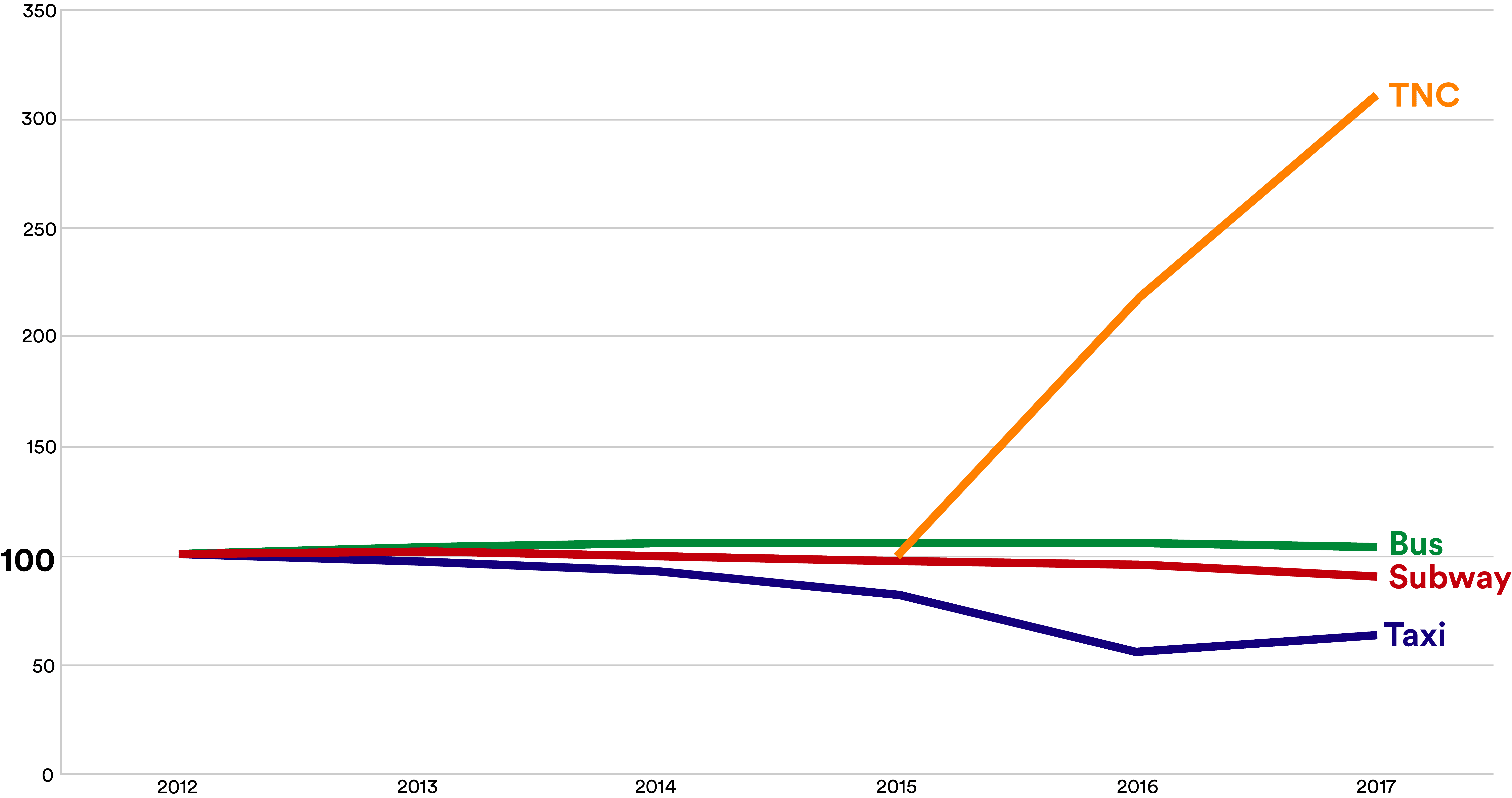
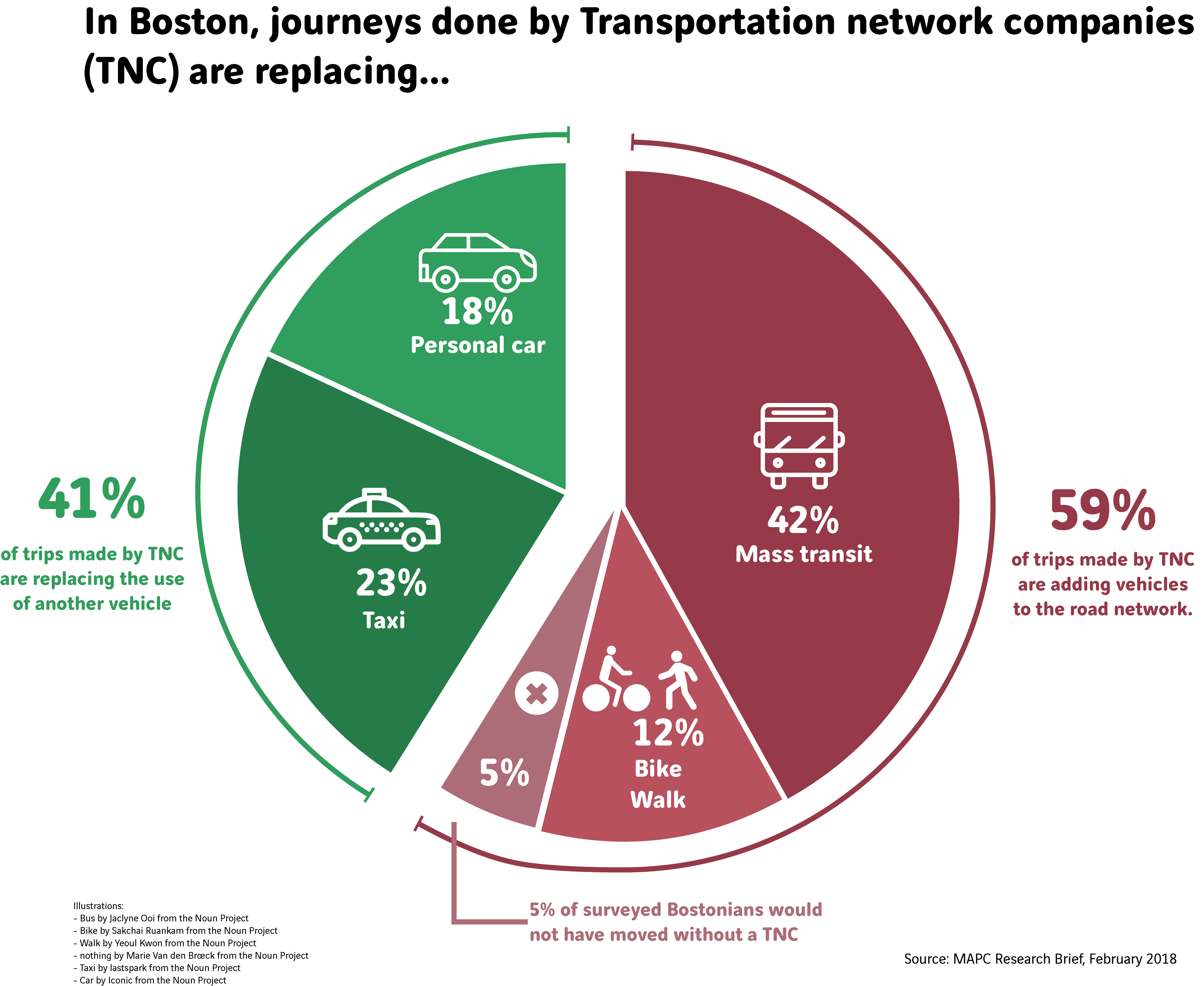
Between 2015 and 2016, and for the first time since 2009, the city saw a decline in ridership on public transit (bus and subway), while Uber and similar services tripled their passenger totals over the same period. Observed in all major U.S. cities6, this trend is especially strong in dense urban areas for trips taken outside of peak travel hours. In the greater Boston area, a study conducted among users of ridehailing services indicated that 42% of users would have taken public transit in the absence of ridehailing services; 12% would have walked or biked; 5% would not have taken the trip. In other words, 59% of trips made by Uber and company put additional vehicles on the streets7. However, we should add some nuance to this data. Though public transit may have lost some ridership in favor of ridehailing services, we have not – yet – seen a dip in the number of transit passes. By competing with traditional modes of transport like public transit, walking and biking, these new digital services have contributed to the rise in urban traffic congestion. This phenomenon represents a major transformation in urban modes of transport: a shift among a portion of mobility demand in favor of these new digital modes. Among these new digital services, ridehailing services have placed additional pressure on traffic congestion. They have simultaneously sparked new mobility demand8 (5% of trips taken with these services) and also replaced a portion of public and non-motorized transit methods (54%). This phenomenon has led to an overall rise in the number of kilometers traveled by car and an increase in urban congestion. Caught unprepared by the intense and fast rise of this phenomenon, public authorities now find themselves in search of answers to this situation. Originally supposed to improve the way people get around, digital mobility services have in fact become one of the main causes of gridlock inside American cities. One notable factor at the root of this situation: the subsequent increase in the number of taxis and chauffeured vehicles in downtown New York9. For example, between 2013 and 2017, the number of ridehailing vehicles more than doubled (from 47,000 to 103,000), while the number of taxis remained capped by city hall at 13,600.
Digital has transformed everything we know about mobility. The data it provides have enabled us to develop more precise transit frameworks, while gaining a comprehensive and real-time vision of mobility solutions. However, this expanded knowledge has not in fact improved the way we regulate and manage traffic flows in urban areas. Behind the information provided to municipal authorities through data sharing partnerships with digital companies, the actual impact of these services continues to disrupt the frameworks and policies designed by public authorities. What explains this paradox in which public authorities, despite having access to more mobility data, have failed to adapt their efforts? How can we explain what amounts to a fundamental paradox of modernity? City planners versus algorithms: this polemical formula describes the latent conflict that has for years pitted municipal authorities against digital companies. For Sam Schwartz, former traffic commissioner for the New York City Department of Transportation, local authorities have been caught off guard11 by the rapid onslaught of new players and services. Nicolas Colin explains this situation by pointing to the fact that the scale of operation of these new players far e?eds the administrative boundaries of any municipality12. The efforts of companies in this new economy have weakened the role of public authorities; but does that mean it heralds a general decline in the role of public authorities in managing urban traffic? For now, as they find themselves overwhelmed and contested from many sides, public authorities are facing a fundamental challenge to their role and legitimacy in urban traffic management.
For example, in France, if the PDU urban transit plans are indeed the cornerstones of mobility planning and scheduling in urban areas13, why haven’t new digital tools expanded and strengthened these plans? It is clear that the efforts and expansion of digital companies do not correspond to the same timeframes and regional boundaries as the traditional stakeholders in urban life. Digital players are agile, responsive and have no geographic boundaries. In this sense, digital companies are the negative image of public authorities. Operating on the basis of medium and long-term planning, public authorities are completely disoriented by the paradigm shift in time and space wrought by the digital economy. Municipalities and public agencies continue to regulate and organize mobility according to timeframes that do not adequately integrate the effects of the new and sudden rise of digital services, notably when it comes to traffic. Contrary to this governmental organization, digital companies have taken a step forward in their approach to mobility. In the first place, they have positioned themselves as intermediaries in the relationship between users and the traditional players in the mobility ecosystem by offering seamless booking and payment, dynamic navigation, real-time information and more. Without needing to fundamentally transform urban mobility, the features made possible by digital technology have facilitated and personalized mobility services, by acting as an intermediary in our daily transit experience. In this way, digital companies have emerged as the new key players in urban mobility.
Secondly, digital players have gradually positioned themselves as key players in personal transportation, taking on a role in the distribution of urban transit14. Traditionally, transit distribution has typically fallen under the scope of ensuring smooth traffic within cities. Public authorities exercised a monopoly over these roles. On the urban level, apart from specific concessions (tunnels, highways) and private roadways, public authorities have always managed the transportation network. Acting simultaneously to regulate traffic and provide public transit services, public authorities continue to play a central role in coordinating individual trips in order to prevent traffic jams in cities. This effort includes coordinated action to manage traffic flows (offering alternative routes, providing incentives to use alternatives to cars), implement an efficient multimodal offer (both streamlined and reliable), upgrading networks (maintenance) and providing information to users15. These actions ultimately aim to ensure streamlined mobility for all citizens, regardless of the mode of transport they choose. But the monopoly held by public authorities over the organization and regulation of urban transit flows has recently encountered a challenge from digital players. Under the impetus of new mobility services, which have convinced citizens of their utility in a remarkably short time span, the legitimacy of public authorities as promoters of transportation services and sources of reliable information on actual traffic conditions is now facing a major challenge. Digital companies owe their success to their ability to identify and capitalize on pressure points in the current network, while closing the real or perceived gaps in public mobility services.
Growing out of the data sharing partnerships frequently promoted by a range of stakeholders, the relationship between urban digital services and municipal authorities has never been easy. This relationship is manifested through the oppositions, tensions and battles that have marked its history. Cities are complex systems which, by their nature, provide the backdrop to confrontations between a range of different players and points of view. For Antoine Picon, Director of Research at École des Ponts ParisTech, “the city is both a political and technical phenomenon“16, intertwining a host of functional and governance issues. As they attempt to solve urban traffic congestion, each stakeholder in the city will implement its own solution. In this way, on top of the vision conveyed by public authorities, digital players will impose their own divergent vision. Determined to conquer cities, these new mobility players have adopted a strategy which, after disrupting the traditional order of business in this sector, now tends to impose its own vision and agenda on public authorities17.
This fundamental change is a new phenomenon. As such, it is either interpreted as a tension between an innovative and agile culture of entrepreneurship aiming to overcome the sluggish bureaucratic pace of public authorities overwhelmed by these issues; or as a predatory dynamic of global economic players against municipalities that are disoriented and caught off-guard by new challenges. As indicated above, public authorities aim to ease traffic along major routes by offering alternative itineraries and an adequate transportation offer. Their role concerns the macro level on the scale of the entire network. Above all, they hold a spatial vision of transit flows. For their part, digital players focus on a simple value proposition: optimizing travel time for individual travelers. In short, their goal is to enable their customers to get where they are going faster or enjoy an enriched travel experience. This vision is primarily temporal and focused on a micro level: the user. Because navigation services have a simple aim: to find “the best itinerary“, the shortest route in both space and time. The key to success for this type of service lies in fact in relying on secondary and tertiary infrastructure networks18 to complement the primary network19 when it becomes too congested. By optimizing itineraries, this feature minimizes travel time and reduces the number of kilometers traveled by cars by preparing an itinerary that combines different networks to obtain the most direct route.
The main difference between these networks lies in their traffic volumes. While the primary network is designed to carry heavy traffic flows (several lanes, high speed), the other two are scaled to provide local and therefore limited service (single lane, moderate speed). Navigation services aspire to optimize networks by shifting a portion of traffic (vehicle flows) to less congested routes – even though the latter were never designed to carry high traffic volumes20. In this way, the secondary network will also break down and experience traffic jams when demand is too high. This means it is impossible to direct e?ss traffic from primary routes to secondary and tertiary networks without creating new traffic jams21. However, many users opt for the alternative itineraries that navigation systems present as faster routes. And this is when the system falls apart. On a basic level, the more traffic is diverted from the primary network to the secondary network, the more it will create new traffic jams in the secondary network22, without necessarily absorbing the e?ss traffic from the primary network. These new traffic jams arise from an inadequate distribution of traffic, caused directly by the digital services promising to offer a “better” itinerary. Though the alternative route may be better from certain angles, it fails to question the model of a single vision managed by a single entity.
“Don’t believe the app“: innovation is not enough Each equipped with its own vision, these different systems do not coexist without conflict. Examples abound of direct opposition between cities and digital players. Including major cities like London23 and Austin24 opposing Uber, as well as small towns like Leonia, New Jersey25 tacking action against the wave of vehicles redirected through its downtown streets every day, these conflicts do not bode well for the possibility of a harmonious relationship between municipalities and digital players. In the meantime, traffic congestion is growing worse in cities, and it seems like nothing can reverse this trend. The problem is complex: as uncertain as the impact of new mobility players on urban congestion may seem, no one can deny that they are revealing the shortcomings of existing mobility services, just as they attempt to respond to these challenges. For that reason, it is more necessary than ever to move beyond this fruitless opposition that benefits no one, e?pt traffic congestion. If the goal is to ease traffic on roadways, cities and digital players need to join their forces in this effort. Of course, this transformation is underway, as new partnerships between municipalities and digital services emerge every day26. Their initial results are encouraging, even though these partnerships have not yet managed to reverse the trend of increasing traffic. In addition to these partnerships, we need to review the fundamentals underlying congestion. Together with Alexandre Bayen, Director of the Institute for Transportation Studies at UC Berkeley, we need to ask the question: “how can we solve the problem if we don’t understand it?”27.
This article is the second installment of a series of four episodes by La Fabrique de la Cité investigating the role of digital technologies in the resolution of cities’ congestion problem.
Illustrations : Fig. 2 :